

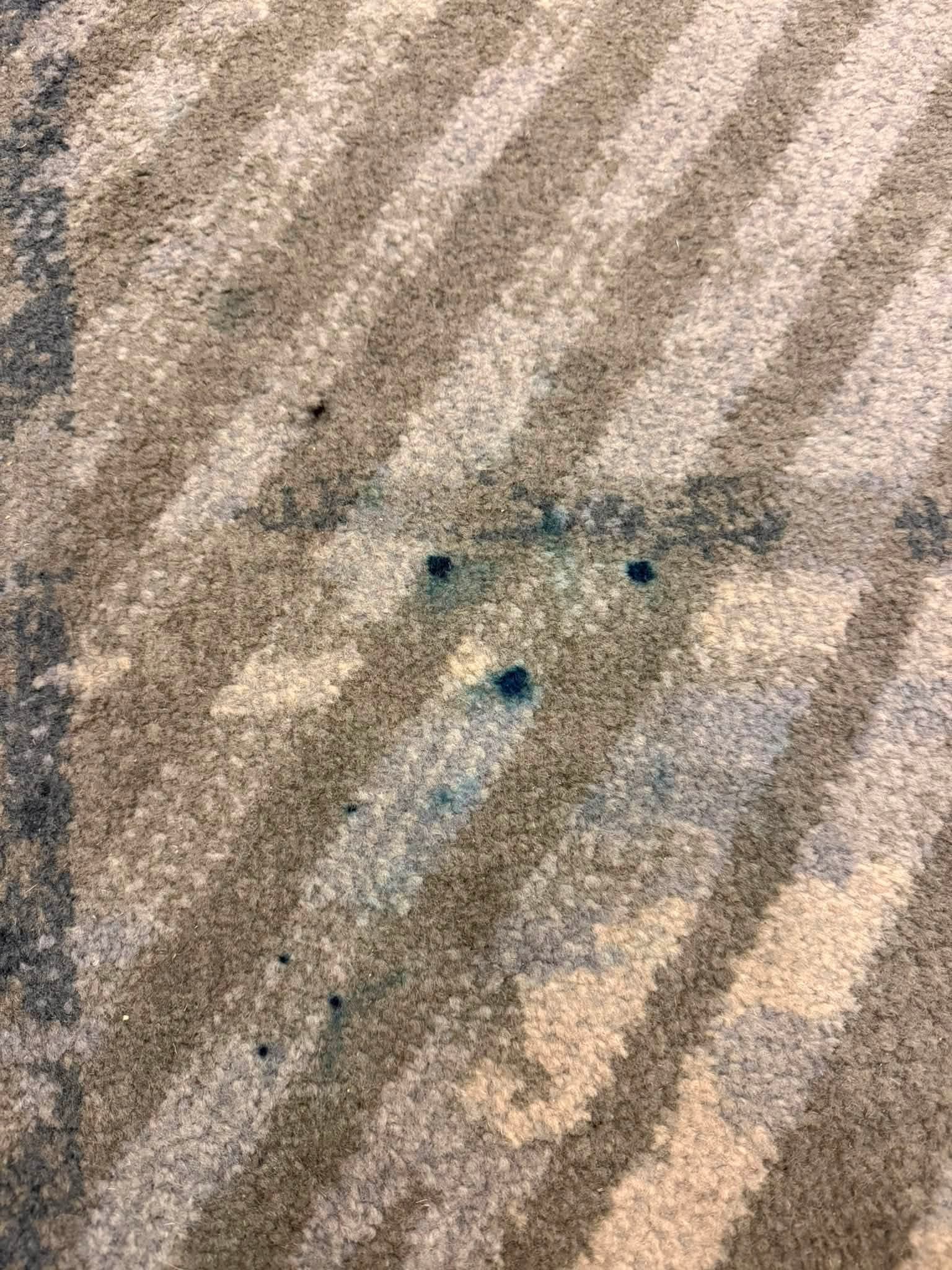
 Before
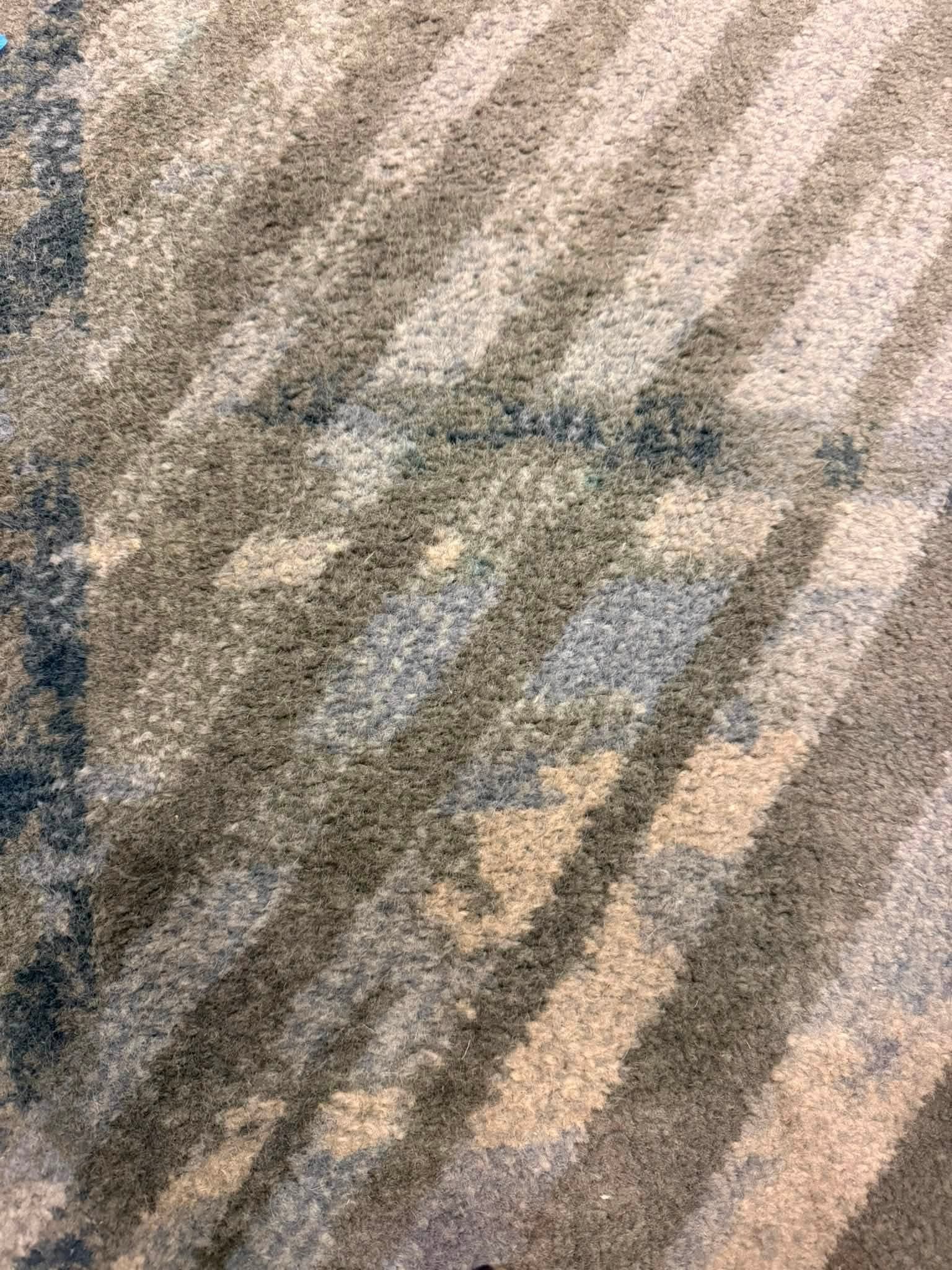 After
AfterWool, commercial broadloom
Ink stains, Falls Church Marriott
A convention left the hotel’s wool carpet with over ninety ink spots. Corrected every spot to match the surrounding field without replacing the carpet.
Wool · Silk · Cotton · Nylon · Acrylic + synthetics on surcharge
Blackthorn Color Corrections is a specialty mobile dye and color-correction service. We repair bleach spots, sun-fade, ink marks, and pet stains on natural fibres and on the trickier synthetics. The result is always darker than the original. Dye deepens tone; it can’t lift it.
Every job is priced in person, after we’ve had a look at the damage. There’s no price list to check against. What we can tell you upfront: it costs a lot less than replacing the rug, or cutting out the damaged section and sewing in a spare patch.
The honest pitch
A heirloom Tabriz, a hand-knotted Oushak, a worn-but-loved cotton Dhurrie: these carry decades of use, character, and the irreplaceable patina of a household. You don’t replace that. You restore it.
It’s also the better repair. The other option, cutting out the damaged section and sewing in a spare piece, leaves a seam, and the weave almost never lines back up exactly. Re-dyeing brings back the whole rug: no patch, no seam.
Every job begins with an in-person look, a written estimate, a dye recipe, and after-care notes. You see the cost first. We don’t touch a fibre before that.
Our dyestuffs are low-VOC, child- and pet-safe, and applied with professional hot-water extraction.
Before & after
A sample of jobs we've completed. Swipe or use the arrows to see more.
BeforeAfterWool, commercial broadloom
Ink stains, Falls Church Marriott
A convention left the hotel’s wool carpet with over ninety ink spots. Corrected every spot to match the surrounding field without replacing the carpet.
Fibres we work on
Each fibre takes dye differently. We tune the bath, the temperature, and the fixative to the weave in front of us.
No surcharge
Wool
the default: deep, even, forgiving.
Cotton
flat weaves, Dhurries, runners.
Silk
used sparingly; vivid + lightfast when fixed correctly.
Nylon
common in machine-made rugs; takes our dyes consistently.
Acrylic
wool-substitute we dye by the same recipe.
Wool & cotton blends
custom two-bath work to match the warp.
Surcharge fibresExtra charge
Viscose
rayon-blend rugs; needs careful pH control and a multi-pass bath.
Polyester
spot-tone only: pigment-bonded, so we re-dye with care.
Polypropylene (olefin)
vivid but difficult: solution-dyed, so only the outer face accepts dye.
Solution-dyed nylon
pigment is locked in at the mill; spot corrections only.
A surcharge fibre just takes more chemistry and handling per pass. That’s the whole reason for the upcharge, not a markup for its own sake. It’s spelled out as its own line on the estimate, so you see it before you agree to anything. The fibres above carry no surcharge; the surcharge list covers viscose, polyester, polypropylene (olefin), and solution-dyed nylon.
The damage we fix
Bleach spots
oxidizer marks from cleaners or peroxide: re-toned, not patched.
Sun fade
UV-baked southern exposure: full-room colour shifts.
Ink & dye-transfer
ballpoint, denim bleed, marker: capped and re-pigmented.
Pet & organic stains
urine, wine, coffee: chemically neutralised before dyeing.
Border recolouring
re-dyed to match the field after years of walking wear.
Pattern rework
commission a new motif over a tired ground.
The one rule that frames every job: dye can only go darker, never lighter.
How the work happens
The job starts with a photograph and ends with a written dye recipe and after-care notes.
A wide shot in good light, a close-up of the damage, and a tape measure alongside for scale. Attach them on our estimate form and we’ll reply within one business day.
Where we work
We travel within about 50 miles of Annapolis for most jobs, across Maryland, D.C., and into Northern Virginia. Farther out? Submit an inquiry anyway and we’ll let you know about any surcharges as part of our estimate process.
Who commissions us
Most of our work comes by referral: people who’ve had the same rug underfoot for ten years and finally decided to deal with the stain. Word of mouth still does the heavy lifting.
Interior designers
specifying heirloom floors for new builds and refits.
Estate & household managers
caring for a long-running inventory of Oriental and European rugs across multiple properties.
Hospitality & STR operators
re-treating high-traffic wool runners every season, plus quick turnarounds between guests.
Insurance adjusters
handling stain claims where the answer is “restore, don’t settle for replacement.”
Antique & auction dealers
touching up acquired pieces before consignment to maximise realised price.
Homeowners
with one rug they cannot bear to throw away.
How pricing works
No price list.
Every job is quoted after we see the rug in person: the damage, the fibre, how many passes it needs. You get the number in writing first, and nothing starts until you say go.
Why it’s worth it
Far less than replacing it.
You keep the rug. Re-dyeing costs a fraction of a new one: same knots, same age, same history, just with the color put right.
Pieces in viscose, polyester, polypropylene (olefin), or solution-dyed nylon carry a fibre surcharge, priced on that same written estimate. It’s never tacked on after we’ve already started.
Common questions
We answer each pre-job enquiry within one business day. If yours isn’t here, write to us directly.
Start with a few photographs
One photo isn’t enough. Send a few: a wide shot of the rug in good light, a close-up of the damage, and a tape measure alongside for scale. That’s enough for us to get the in-person visit on the calendar.
We reply within one business day.